


Game Production
The Lumberyard Engine: From Amazon to the Open 3D Engine
Amazon's Lumberyard engine is based on CryEngine and is now open source as the Open 3D Engine. We explain its history, features, and technology.
Tim Rantzau

Game Production
Lumen is the dynamic global illumination system in Unreal Engine 5. We explain how the real-time lighting works, how to enable it, and where its limits are.
Realistic lighting was long one of the most expensive parts of game development. Light had to be precomputed and "baked" into so-called lightmaps, which turned every change to a scene into a lengthy process. With Lumen, Unreal Engine 5 breaks with this approach. Lumen is the engine's fully dynamic global illumination and reflection system, and it calculates indirect light in real time, across any distance.
The result: when something in the scene changes, the time of day, a light source, or an entire building, the lighting adapts instantly. No waiting, no re-baking. Let us look at how this technology works and where it reaches its limits.
Lumen solves diffuse indirect lighting, where light bounces off a surface, picks up its color, and transfers it to nearby surfaces. This effect, called color bleed, is one of the reasons computer-generated scenes only start to feel truly believable. In addition, Lumen calculates reflections in real time. Technically, the system combines a low-resolution representation of the scene lighting with software ray tracing, and uses hardware ray tracing where available.
Lumen was developed from the start for the current console generation from Sony and Microsoft and is closely intertwined with the geometry system Nanite. Both technologies are the central innovations that let Unreal Engine 5 render photorealistic scenes.
In new projects in Unreal Engine 5, Lumen is active from the start. Existing projects imported from Unreal Engine 4, on the other hand, do not enable Lumen automatically, so as not to disturb the existing lighting. You can switch it on at any time in the Project Settings under Rendering. Set the "Dynamic Global Illumination Method" and the "Reflection Method" to Lumen.
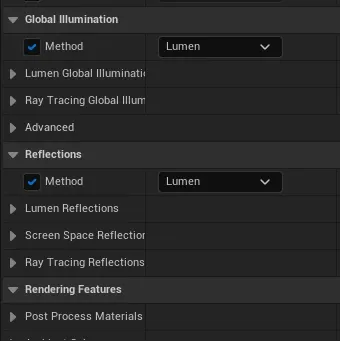 Lumen is enabled in the Project Settings under Rendering
The biggest gain is the workflow. Because Lumen uses a dynamic pipeline for indirect light, you can change geometry, materials, and light sources at any time and see the result immediately. The waiting times until the final lighting quality is calculated disappear. For artists, that means far more freedom to experiment. On top of that, Lumen delivers geometrically precise reflections and works seamlessly with Nanite, so highly detailed scenes are lit correctly.
Like any young technology, Lumen still has restrictions. Classic static lighting via lightmaps cannot be combined with Lumen's global illumination, and the reflections do not support multiple mirror bounces within each other. The system also reaches its limits with certain water and special materials. Worth knowing: Epic Games noticeably improves Lumen with every Unreal Engine version, for example in reflection quality and performance. Much of what was missing in early versions has since been added.
Lumen is one of the reasons the Unreal Engine is now used far beyond classic games, from architectural visualizations to interactive real-time applications. These are exactly the kind of projects we build at Studio Merkas with the Unreal Engine. If you are planning an interactive 3D or real-time application and want to know what is possible with Lumen, Nanite, and the like, get in touch with us.

Ready to get started?
We appreciate your interest in working with us. Whether you have an idea, a proposal, a question, or need assistance in another area, we’ll get back to you quickly—within 24 hours.